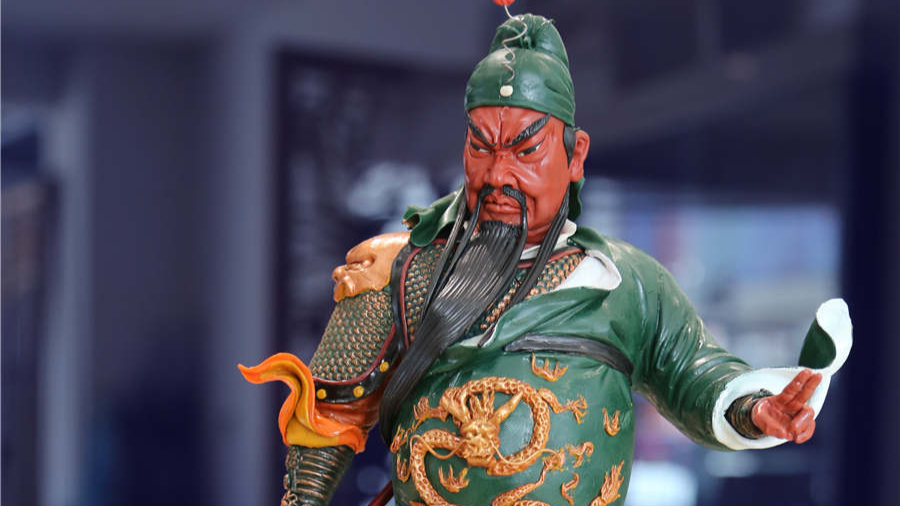
Guan Yu
Introduction
Guan Yu, also known as Guan Gong or Guan Di, is a prominent figure in Chinese history, widely celebrated for his martial prowess, unwavering loyalty, and integrity. He lived during the turbulent Three Kingdoms period (220-280) and was a key general serving under the warlord Liu Bei. Over the centuries, Guan Yu's legacy has transcended his historical role, leading to his deification as a symbol of loyalty, valor, and righteousness. His influence permeates Chinese culture, both within the country and among overseas Chinese communities.
Guan Yu's story is intertwined with historical events and cultural narratives that have elevated him to the status of a deity. His character is often associated with the values of loyalty and courage, which are deeply respected in Chinese society. As a deity, Guan Yu is worshipped as the God of War, and he is revered in Taoist traditions. His image can be found in temples, homes, and businesses, where he is invoked for protection and prosperity.
The cultural significance of Guan Yu is vast, extending into arts, literature, and various forms of media. His life and deeds have been immortalized in the classic Chinese novel "Romance of the Three Kingdoms," which dramatizes his exploits and highlights his virtues. This literary portrayal has cemented his status as one of China's most revered historical figures, inspiring countless adaptations in operas, films, and television shows.
Life and Career
Early Life
Guan Yu was born in the late Eastern Han Dynasty, in a village near present-day Yuncheng in Shanxi province. Little is known about his early life, but he is said to have displayed remarkable courage and loyalty from a young age. These traits would later define his role as a military general and loyal follower of Liu Bei. Guan Yu's early years were marked by a sense of justice and righteousness, which he carried with him throughout his life.
Service under Liu Bei
Guan Yu became one of Liu Bei's closest confidants and one of the most trusted generals in his army. His loyalty to Liu Bei was legendary, even to the point of risking his life multiple times to ensure the safety and success of his master. Guan Yu's strategic brilliance and martial skills were crucial in aiding Liu Bei's ambitions to restore the Han Dynasty by establishing the state of Shu Han. His service under Liu Bei was marked by significant battles and campaigns where his bravery and tactical acumen were on full display.
Role in the Three Kingdoms
During the Three Kingdoms period, Guan Yu played a pivotal role in the power struggles between the warring states of Wei, Shu, and Wu. He participated in numerous battles and was instrumental in several key victories for Shu Han. Notable among these was his defense of Jingzhou, a strategically vital region that became a flashpoint for conflict between the rival states. Guan Yu's leadership and combat prowess earned him both respect and fear from his adversaries, solidifying his reputation as an iconic military figure.
Cultural Significance
As a Deity
Following his death, Guan Yu was posthumously deified and came to be worshipped as a god of war and righteousness. His deification was a gradual process, beginning in the Sui and Tang dynasties, and culminating during the Song Dynasty when he was officially canonized as Guandi. Temples dedicated to Guan Yu, known as Guandi Temples, are widespread throughout China and abroad, serving as sites of worship and pilgrimage for devotees seeking his protection and blessings.
Influence in Arts and Literature
Guan Yu's life and deeds have been a rich source of inspiration for artists and writers throughout Chinese history. His character is central to the "Romance of the Three Kingdoms," one of China's most famous works of historical fiction. This novel, along with countless operas, plays, and films, has immortalized Guan Yu as a paragon of virtue and heroism. His image is frequently portrayed in traditional Chinese paintings, sculptures, and other art forms, reflecting his enduring legacy and cultural impact.
Legacy
Temples and Shrines
Temples and shrines dedicated to Guan Yu are scattered across China and beyond, testament to his widespread veneration. The most notable among them is the Temple of Emperor Guan in Xiezhou, Yuncheng, which is renowned for its historical significance and architectural beauty. These sites serve not only as places of worship but also as cultural landmarks that celebrate Guan Yu's contributions and the values he embodies.
The Chengdu Wuhou Shrine hosted an exhibition featuring over 110 ancient artifacts, showcasing the enduring essence of Guan Yu's spirit. The exhibition bridged past and present, offering a comprehensive view of his cultural impact.
Popular Culture
Guan Yu's influence extends into popular culture, where he is depicted in a variety of media, including films, television series, and video games. His character is often associated with themes of loyalty, righteousness, and martial excellence, making him a fitting subject for stories that celebrate these virtues. Composers and performers continue to pay tribute to Guan Yu in music and dance, as seen in the dance drama "Guan Gong," which portrays his struggles and heroism. Additionally, his image is commonly used in businesses and homes, symbolizing protection and prosperity, and underscoring his role as a cultural icon.








